Food Production: Agriculture
After a lengthy diversion, this post continues the series on food production in Azeroth by looking at the fine art of digital agriculture. Grains, vegetables, fruits—if the grocers and bakers in Dalaran sell it, then a farmer probably provides it. All this food production seems to happen invisibly, but surely there must be enormous spice fields supplying raids with buff food, rippling wheat fields providing flour for each faction's traditional bread, large-scale orchards whence fruit-sellers like Applebough get their organic wares, and vast vineyards stocking the wine-cellars in every town inn (keeping in mind that when in Dalaran, the custom is to drink only half one's glass of wine, inflating the quantity required to quench Dalaranian thirsts).
I took a brief tour through Azeroth in search of large-scale agricultural endeavors that might supply Azeroth's hungry citizens. My observations are mostly focused on the Alliance; the Horde can probably get by just fine relying solely on cannibalism or grazing (I kid, I kid). In my opinion, Humans seem to be the only ones pursuing any kind of organized agriculture; the Draenei and Gnomes are both still coasting on their refugee status, the Dwarves enthusiastically stave off hunger with beer, and the Night Elves simply hibernate in the Emerald Dream when they get a little peckish. Well not really, and in fact there are some respectable Dwarven farmers in the mountains between Ironforge and Menethil Harbour. There are fields in a number of Azeroth's zones, primarily in the Eastern Kingdoms where the Humans have radiated from their ancestral home of Stromgarde and developed various kingdoms. But the farms are, for the most part, now overrun by bandits, zombies, rabid beasts, or anything fundamentally hostile. All things considered, I think we should brace ourselves for widespread famine that is sure to come on the heels of agriculture's collapse, particularly if Azerothians continue to consume with reckless abandon.
Hillsbrad Foothills Food Industry
 The Hillsbrad Foothills offer some of the most fertile soil in the upper Eastern Kingdoms. Tucked in the Alterac Mountain range, Ravenholdt Manor looks out upon a well-tended garden. Although Simone Cantrell (pictured at left) calls herself a "Landscape Architect," her modest garden plot features edible crops like mushrooms and leafy vegetables. This alpine garden is hidden away from inquisitive travelers with the aid of a well-guarded tunnel, and the Ravenholdt don't share their bounty with outsiders.
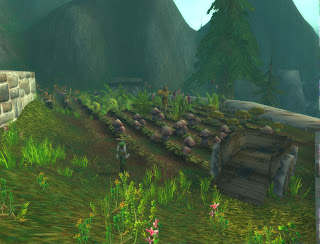
 At lower altitudes, the commercial agriculture starts in earnest. The area known as Hillsbrad Fields, in particular, boasts thriving orchards, vineyards, and vegetable patches that produce bumper crops, with scores of peasants working industriously to bring in the harvest. Although fertile, this farming region probably only provides enough food for the Hillsbrad Foothills area; perhaps some surplus is sent to Stormwind via the port at Southshore, but likely not much. The Hillsbrad Fields region primarily supplies the produce section of the grocery store; grain cr
 ops are raised elsewhere in Azeroth.
Hillsbrad Fields boasts two whole fields of apple trees, industriously tended by peasants filling bushel baskets with the ripe fruit. In addition, the region is home to pumpkin patches (a crop that thrives just about everywhere in Azeroth, including plagued areas) and grape vines.
Grain Farming
Westfall was probably once the breadbasket of Azeroth; the sunny plains are just right for grain on the numerous farm estates. Unfortunately, the many of the fields have been overrun by hostile squatters, so production has stalled in much of the zone. Nevertheless, there are still respectable farmers—like the Saldeans—who keep their foothold in Westfall.
 Some of the encroaching squatters are bandits, like the Defias gang or the Riverpaw clan of gnolls. Vicious murlocs generally steer clear of the farmland, but hold the beaches of Westfall. In some areas, mechanical harvest golems appear to have malfunctioned and become dangerous, chasing farmers off their land—a classic tale of robotic inventions turning against their makers. Hungry vultures have descended on some fields, undeterred by scarecrows and wreaking havoc on crops. And on top of all this, prairie dogs run rampant throughout the entire zone, nibbling from fields and grain stores. There is little the farmers can do against such persistent enemies; calling in bounty hunters hardly makes a dent in their numbers. Most farmers, like Farmer Furlbrow, have been run off their own land and now spend their time fretting about belongings they have left behind, bereft of even a handful of oats with which to feed their loyal workhorse.
 Highwaymen and menacing vultures aren't the only trouble, though; at that latitude, a perpetual autumn has set in. Although this makes for very fine harvesting conditions, the growing conditions aren't as prime. Everything has subsided into a dry, brown dormancy, with only the occasional patch of forlorn crop still standing unharvested. This zone certainly can't sustain vineyards anymore, like the one pictured at left. Those crackly brown leaves have died off, and no gentle spring rain will renew them.
 One product Westfall does abound in are haystooks. The hay standing in golden bundles across the landscape could feed many livestock corrals, but Westfall itself has no meat industry. The hay could be exported to places like Hillsbrad that don't have much grain farming, but with the way things are looking in Westfall ecologically, it would likely be a non-renewable resource. The cropland is too dessicated—not to mention war-torn—to provide ongoing supplies of cattle feed. Perhaps some day the climate will change enough to raise new crops, and the Westfall farmers will reclaim their homeland from the bandits and wayward robots. Until then, the fields will lie in fallow and the stooks will stand mouldering.
In addition to Westfall's recently-abandoned agricultural lands, the other former Human kingdoms display fields in more advanced stages of decay. In Western Plaguelands—clearly once a farming region—both town and countryside has fallen to hordes of undead, and a thick hazy blight hangs over the land. In a grotesque twist of irony, the major farmsteads—once fertile sites of grain production—are now monstrous sites of plague production. There, enormous festering cauldrons perpetually brew a Plague of Undeath, distilling the plague into the air and creating the cloak of poison that hangs over the land. Tirisfal Glades—surrounding the pestilent Forsaken city festering below the ruins of Lordaeron—still holds decaying farming structures like windmills and granaries, but its fields are now zombie stomping-grounds.
Orchards
 Some regions of Azeroth carry a reminder of long-abandoned agriculture. Total darkness has taken its toll on the Rotting Orchard, pictured at left. Located in Darkshire, this stand of lifeless, skeletal trees is now overrun by malevolent worgen. Evil lurks everywhere
 in the shadowy forests of Darkshire, and it would take massive ecological change for that zone to support agriculture again. Far to the north, overgrown orchards left over from happier times can be found in Silverpine Forest (pictured at right).
Fruits and Vegetables
 Who doesn't love pilfering a ripe pumpkin fresh from the patch? Or plucking a succulent watermelon and enjoying it right off the vine? Pumpkins are an Azerothian favourite, and can be found in both well-tended commercial fields and small family patches. In Elwynn Forest, the major pumpkin supplier once cultivated Brackwell Pumpkin Patch in the Southeast; but beware if you're a green young toon hankering after a moon harvest pumpkin—both Defias thugs and dangerous swine currently patrol this farm. Similarly, Fulbrow's Pumpkin Patch in Westfall has been taken over by the Defias gang and feral harvest golems. Rogue pumpkin patches can also be found in overrun areas like Tirisfal Glades, thriving despite the contagion of their neighbours.
Watermelons, too, seem to be a favourite Azerothian crop. Elwynn Forest's Stonefield Farm is (so far) free from Defias banditry, though the farm's rivalry with the nearby MacLure Vineyards is a battle unto itself.
So commercial agriculture certainly exists in Azeroth, though perhaps not on a scale that could stave off food shortage. Tune in later in the Food Production series, when I'll tackle such fascinating topics as livestock, foraging, and hunting.
I took a brief tour through Azeroth in search of large-scale agricultural endeavors that might supply Azeroth's hungry citizens. My observations are mostly focused on the Alliance; the Horde can probably get by just fine relying solely on cannibalism or grazing (I kid, I kid). In my opinion, Humans seem to be the only ones pursuing any kind of organized agriculture; the Draenei and Gnomes are both still coasting on their refugee status, the Dwarves enthusiastically stave off hunger with beer, and the Night Elves simply hibernate in the Emerald Dream when they get a little peckish. Well not really, and in fact there are some respectable Dwarven farmers in the mountains between Ironforge and Menethil Harbour. There are fields in a number of Azeroth's zones, primarily in the Eastern Kingdoms where the Humans have radiated from their ancestral home of Stromgarde and developed various kingdoms. But the farms are, for the most part, now overrun by bandits, zombies, rabid beasts, or anything fundamentally hostile. All things considered, I think we should brace ourselves for widespread famine that is sure to come on the heels of agriculture's collapse, particularly if Azerothians continue to consume with reckless abandon.
Hillsbrad Foothills Food Industry
 The Hillsbrad Foothills offer some of the most fertile soil in the upper Eastern Kingdoms. Tucked in the Alterac Mountain range, Ravenholdt Manor looks out upon a well-tended garden. Although Simone Cantrell (pictured at left) calls herself a "Landscape Architect," her modest garden plot features edible crops like mushrooms and leafy vegetables. This alpine garden is hidden away from inquisitive travelers with the aid of a well-guarded tunnel, and the Ravenholdt don't share their bounty with outsiders.
 At lower altitudes, the commercial agriculture starts in earnest. The area known as Hillsbrad Fields, in particular, boasts thriving orchards, vineyards, and vegetable patches that produce bumper crops, with scores of peasants working industriously to bring in the harvest. Although fertile, this farming region probably only provides enough food for the Hillsbrad Foothills area; perhaps some surplus is sent to Stormwind via the port at Southshore, but likely not much. The Hillsbrad Fields region primarily supplies the produce section of the grocery store; grain cr
 ops are raised elsewhere in Azeroth.
Hillsbrad Fields boasts two whole fields of apple trees, industriously tended by peasants filling bushel baskets with the ripe fruit. In addition, the region is home to pumpkin patches (a crop that thrives just about everywhere in Azeroth, including plagued areas) and grape vines.
Grain Farming
Westfall was probably once the breadbasket of Azeroth; the sunny plains are just right for grain on the numerous farm estates. Unfortunately, the many of the fields have been overrun by hostile squatters, so production has stalled in much of the zone. Nevertheless, there are still respectable farmers—like the Saldeans—who keep their foothold in Westfall.
 Some of the encroaching squatters are bandits, like the Defias gang or the Riverpaw clan of gnolls. Vicious murlocs generally steer clear of the farmland, but hold the beaches of Westfall. In some areas, mechanical harvest golems appear to have malfunctioned and become dangerous, chasing farmers off their land—a classic tale of robotic inventions turning against their makers. Hungry vultures have descended on some fields, undeterred by scarecrows and wreaking havoc on crops. And on top of all this, prairie dogs run rampant throughout the entire zone, nibbling from fields and grain stores. There is little the farmers can do against such persistent enemies; calling in bounty hunters hardly makes a dent in their numbers. Most farmers, like Farmer Furlbrow, have been run off their own land and now spend their time fretting about belongings they have left behind, bereft of even a handful of oats with which to feed their loyal workhorse.
 Highwaymen and menacing vultures aren't the only trouble, though; at that latitude, a perpetual autumn has set in. Although this makes for very fine harvesting conditions, the growing conditions aren't as prime. Everything has subsided into a dry, brown dormancy, with only the occasional patch of forlorn crop still standing unharvested. This zone certainly can't sustain vineyards anymore, like the one pictured at left. Those crackly brown leaves have died off, and no gentle spring rain will renew them.
 One product Westfall does abound in are haystooks. The hay standing in golden bundles across the landscape could feed many livestock corrals, but Westfall itself has no meat industry. The hay could be exported to places like Hillsbrad that don't have much grain farming, but with the way things are looking in Westfall ecologically, it would likely be a non-renewable resource. The cropland is too dessicated—not to mention war-torn—to provide ongoing supplies of cattle feed. Perhaps some day the climate will change enough to raise new crops, and the Westfall farmers will reclaim their homeland from the bandits and wayward robots. Until then, the fields will lie in fallow and the stooks will stand mouldering.
In addition to Westfall's recently-abandoned agricultural lands, the other former Human kingdoms display fields in more advanced stages of decay. In Western Plaguelands—clearly once a farming region—both town and countryside has fallen to hordes of undead, and a thick hazy blight hangs over the land. In a grotesque twist of irony, the major farmsteads—once fertile sites of grain production—are now monstrous sites of plague production. There, enormous festering cauldrons perpetually brew a Plague of Undeath, distilling the plague into the air and creating the cloak of poison that hangs over the land. Tirisfal Glades—surrounding the pestilent Forsaken city festering below the ruins of Lordaeron—still holds decaying farming structures like windmills and granaries, but its fields are now zombie stomping-grounds.
Orchards
 Some regions of Azeroth carry a reminder of long-abandoned agriculture. Total darkness has taken its toll on the Rotting Orchard, pictured at left. Located in Darkshire, this stand of lifeless, skeletal trees is now overrun by malevolent worgen. Evil lurks everywhere
 in the shadowy forests of Darkshire, and it would take massive ecological change for that zone to support agriculture again. Far to the north, overgrown orchards left over from happier times can be found in Silverpine Forest (pictured at right).
Fruits and Vegetables
 Who doesn't love pilfering a ripe pumpkin fresh from the patch? Or plucking a succulent watermelon and enjoying it right off the vine? Pumpkins are an Azerothian favourite, and can be found in both well-tended commercial fields and small family patches. In Elwynn Forest, the major pumpkin supplier once cultivated Brackwell Pumpkin Patch in the Southeast; but beware if you're a green young toon hankering after a moon harvest pumpkin—both Defias thugs and dangerous swine currently patrol this farm. Similarly, Fulbrow's Pumpkin Patch in Westfall has been taken over by the Defias gang and feral harvest golems. Rogue pumpkin patches can also be found in overrun areas like Tirisfal Glades, thriving despite the contagion of their neighbours.
Watermelons, too, seem to be a favourite Azerothian crop. Elwynn Forest's Stonefield Farm is (so far) free from Defias banditry, though the farm's rivalry with the nearby MacLure Vineyards is a battle unto itself.
So commercial agriculture certainly exists in Azeroth, though perhaps not on a scale that could stave off food shortage. Tune in later in the Food Production series, when I'll tackle such fascinating topics as livestock, foraging, and hunting.
Labels: agriculture, farming, food production, fruits, Humans, orchards, vegetables
posted at
1:30 PM
0 comments


0 Comments:
Post a Comment
<< Home